
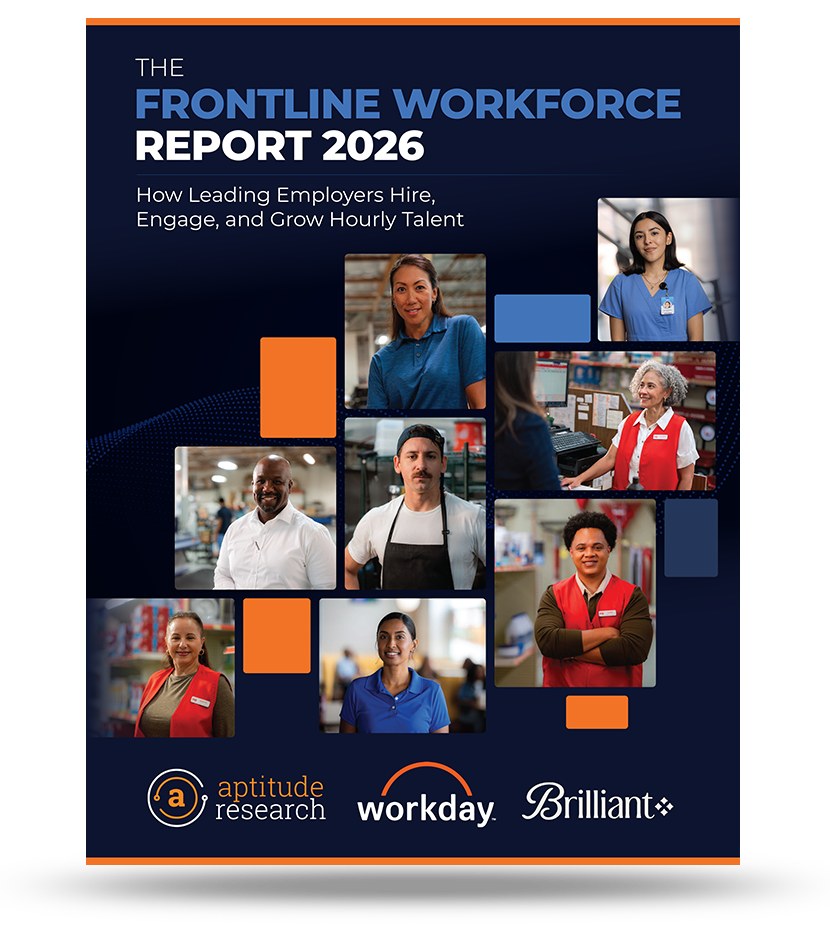
Frontline workers are nearly 80% of US employment, more than 100 million people. For years, the conversation about them has focused on how hard its is to recruit and retain frontline workers. Our new research suggests the fix may be easier than many employers think.
The Frontline Workforce Report 2026, sponsored by Workday and Brilliant, looked at what frontline workers actually want and it wasn’t a lot. A response after applying. A schedule they can plan around. Clear information about their pay. A manager who communicates. None of these require a major investment. Most rely on tools employers already have.
Employers have also made real progress. 60% now say talent acquisition or HR owns frontline hiring, up from fewer than 30% of hourly focused organizations in 2020. 84% let candidates apply on a phone. 74% use AI somewhere in frontline hiring. The foundation is in place. The opportunity now is to extend it to the everyday experience of work.
Hiring. Workers want an application they can finish and an answer when they do. 79% of hourly workers have abandoned an application because it took too long. Only 22% of employers respond to 90% or more of frontline applicants. Most organizations already have the communication tools to close that loop. Workers are also open to AI in the process. 78% have used an AI assistant or chatbot when applying, and 67% said it made the experience better.
Engagement. Workers want to hear from their manager and reach basic information from their phone. 83% say communication with their direct manager matters. 52% are satisfied. Their tool requests are practical: 46% want mobile access to pay stubs and tax forms, 35% want to request time off digitally, and 27% want to see their schedule. Meanwhile, 51% of employers say fewer than three quarters of their frontline workers have a company email or login. Meeting workers on the channels they use is a straightforward first step.
Pay. Workers want clarity and access. 84% say clear pay information is important, and 57% are satisfied with what they get. 69% check their pay after every shift. 63% of employers offer earned wage access, yet 55% of workers say they have none. Among workers with six or more years of service, 81% want it and 29% have it. The information workers want already sits in payroll systems. The benefit often already exists. The next step is communication and enrollment.
Scheduling. Workers want notice and a little control. 45% rank their schedule among the top three reasons they took their job, second only to pay. 73% want their schedules in advance, but one in three employers publishes less than a week out. 53% of employers let workers view a schedule, and 12% let them swap a shift. Most scheduling systems can already support swaps and open shift pickup. Turning those features on would also give back time to managers, 55% of whom spend three or more hours a week building schedules.
Mobility and retention. Workers want a path forward, and employers are well positioned to offer one. 56% fill most frontline manager roles from within, and 62% give frontline workers a system to see internal openings. The main barrier is incentives. 48% say managers do not want to lose strong performers, and only 20% tie any part of manager pay to retention. Adding retention and internal promotion to the manager scorecard aligns managers with what the business already wants.
The labor market is near parity, with about one unemployed person for every open job, so employers have room to make changes. At the same time, birth rates are at a record low, more than 4 million Americans turn 65 each year, and immigration has slowed. The pool of future frontline workers is shrinking, and the employers who act now will be better positioned when competition returns.
Frontline workers are asking for control over their time, clarity about their money, and tools as simple as the ones they use everywhere else. These are reasonable requests, and most employers already have what they need to meet them.
Thank you to Workday and Brilliant for partnering on this research.